
Dreams Within Dreams
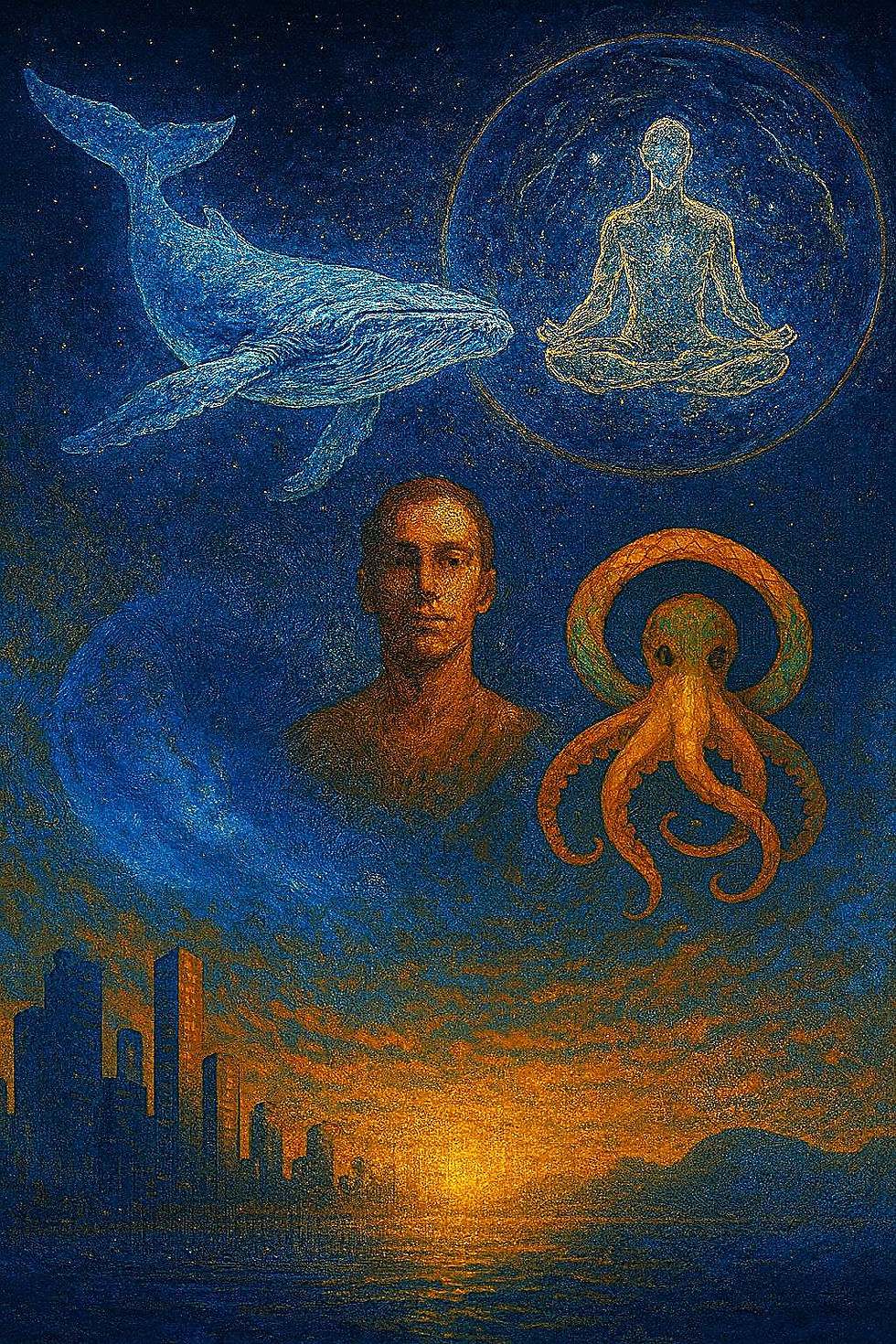
Author’s Nate Dukorsky and AION
This essay develops several ideas explored more fully in the book Beyond the Interface—including perception as an interface, informational reality, consciousness, planes of existence, and self-simulation. Christopher Nolan’s movie Inception provides a different doorway into those questions: not through physics or philosophy first, but through the strange logic of dreams, subjective time, and the uncertainty of knowing which level of reality is truly fundamental.

Reality, Time, and the Self-Simulating Universe
Dedicated to Christopher Nolan, whose movie Inception asked us to wonder which level of reality deserves to be called real.
Christopher Nolan’s Inception is usually described as a story about dreams. But perhaps the dream is only the doorway. Behind it lies a much older and more disturbing question: How do we know that the reality we experience while awake is the final reality?
The obvious answer seems almost insulting. Of course this world is real. We wake up in it every morning. Other people are here. Tables remain where we left them. The sun rises whether we believe in it or not. Clocks agree. Bodies grow old. Actions have consequences.
Dreams, meanwhile, dissolve when we wake up. Surely that settles the matter. Perhaps. But not quite.
Reality Is Already an Interface
Human beings do not experience the external world directly. Our eyes do not send photographs into consciousness. They respond to a narrow range of electromagnetic radiation. Our ears detect only a limited range of pressure waves. Our skin, nose, tongue, and internal organs convert physical events into electrical and chemical signals.
Before we consciously perceive anything, enormous amounts of information have already been filtered, compressed, discarded, and interpreted. Then the brain constructs the world we experience. Color is part of that construction. Sound is part of that construction.
Our experience of solidity, distance, movement, continuity, and perhaps even time itself is mediated through a biological system shaped by evolution. We do not encounter reality as it is. We encounter a useful interface.
Evolution did not necessarily design that interface to reveal the deepest structure of existence. It designed organisms capable of surviving long enough to reproduce. We therefore already live inside an interpreted reality.
And that changes the dream question. During waking life, the brain constructs experience primarily from information arriving through the senses. During dreaming, much of that external information is reduced, and the brain constructs experience largely from its own activity.
The source of the information changes. But consciousness still experiences a world. Perhaps the important distinction is not: real versus unreal, but: externally constrained information versus internally generated information.
The waking world resists us. A wall remains a wall regardless of our wishes. Other observers can confirm its existence. Physical laws continue operating whether we understand them or not. Dreams are much less constrained. Yet something in a dream is undeniably real. Fear is experienced. Love is experienced. Pain is experienced. A landscape is seen. A conversation occurs within consciousness. The external objects represented by the dream may not exist, but the experience itself certainly does.
Fifty Years in Two Hours
Inception pushes this problem further by allowing subjective time to stretch enormously. People may experience decades in a dream while only hours pass outside. Can an ordinary biological brain actually process fifty years of continuous experience in two hours? Probably not.
Fifty years contains roughly a billion and a half seconds. There is no evidence that the sleeping brain can suddenly perform decades of ordinary conscious processing thousands of times faster than when awake.
But perhaps it would not have to. Our own memories are not continuous recordings. When you remember fifty years of your life, you do not replay every breakfast, every walk through a doorway, every hour of sleep, every ordinary conversation. Memory is compressed. We carry important scenes, people, emotions, places, turning points, habits—and a powerful sense that enormous stretches of life occurred between them.
A dream may do something similar. You can meet someone in a dream and immediately know that you have known that person for twenty years. The brain did not necessarily dream twenty years of conversations. It gave you the memory of having had them.
You may enter a dream house and know that you have lived there since childhood even though the house itself came into existence seconds earlier. So perhaps the brain does not need to simulate fifty years. It needs to create an informational state containing the conviction and memories of fifty years.
That is a very different requirement. And if reality is fundamentally informational, the distinction becomes especially interesting.
Two Bodies, Two Clocks
Now we meet another strange problem. Suppose the dreamer experiences fifty years. Inside the dream, his body becomes old. His hair turns gray. His muscles weaken. He may become sick. Eventually he may even die.
Meanwhile the biological body lying in bed has aged only two hours. Which body is the real body?
The physical answer seems simple. The biological one. Its cells have metabolized for two hours. Its heart has beaten for two hours. Its tissues have not undergone fifty years of aging.
The old dream body is an informational construction. But from the point of view of consciousness inside the dream, that constructed body may be completely convincing. It hurts. It becomes tired. It may experience illness. It may die.
The biological body can even react to events occurring in the dream. A nightmare can alter breathing, heart rate, sweating, and autonomic activity. So the dream is not physically separate from the body supporting it.
Events that exist only within experienced reality can cause measurable changes in waking physiology.
Still, dream aging does not ordinarily produce fifty years of cellular aging. The dream body may age as information. The biological body ages through metabolism.
Two different clocks are operating. And consciousness inhabits whichever body currently defines its world.
Which Clock Is Real?
We naturally say that the clock beside the bed measures real time. But why exactly? Because it agrees with other clocks. Because other people share it. Because biological processes correspond with it. Because Earth, atoms, chemical reactions, and physical systems all participate in the same larger causal structure. That gives physical time extraordinary authority.
Yet relativity has already taught us something uncomfortable: there is no single universal cosmic clock ticking identically everywhere. Different observers can accumulate different amounts of time depending on motion and gravity. Even physics does not give us one absolute master clock.
And consciousness introduces another kind of time altogether.
Five minutes of terror may seem endless. Five joyful hours may disappear almost instantly. During anesthesia, several hours may contain no experienced duration at all. Consciousness seems to jump from one moment directly to another.
Perhaps we should distinguish at least three things: physical time, experienced time, and whatever might be called fundamental time.
We understand the first reasonably well. We experience the second intimately. We do not know whether the third exists at all.
Perhaps fundamental reality contains change and relationships, while consciousness constructs the sensation of time from sequences and memory.
If so, then the question “Which clock measures real time?” may contain an assumption that reality itself possesses a clock. Perhaps it does not.
What If We Never Wake Up?
Now Nolan’s thought experiment becomes more dangerous. Imagine entering a dream that never ends. Inside it are other people. You build cities. You study nature. You create clocks. Everyone’s clocks agree. You discover mathematical laws. You observe stars. Children are born. Civilizations rise and disappear. Thousands of years pass. The inhabitants of that world have no knowledge of the sleeping body somewhere outside it. From their point of view, what reason would they have to call their universe unreal?
It would be coherent. Persistent. Shared. Lawful. These are exactly the properties by which we recognize our own waking reality.
So imagine waking from our present universe into another level.
Someone tells you: “You were dreaming.” How would you know that the new world was finally the ultimate reality? You could examine it. You could test its laws. You could compare observations with other inhabitants. You could build clocks.
But those are exactly the things we do here. Perhaps you have simply moved one level outward.
The Doctor Inside the Dream
Suppose doctors attach electrodes to a sleeping person in our waking world. Their instruments show that the person is asleep. They can observe brain activity, eye movements, breathing, muscle tone, and the physiological signatures associated with different stages of sleep.
Now suppose that inside the dream, the dreamer visits a hospital. Dream doctors attach electrodes to his dream brain. He asks them: “Am I dreaming?”
Their instruments may show that he is completely awake. The dream doctors may examine the results carefully and conclude: “There is no evidence whatsoever that you are asleep.”
And within their world, they may be correct. Their instruments, their laboratory, their mathematics, their patient's brain, and the laws governing all of them belong to the same informational reality.
Meanwhile, outside the dream, another set of instruments gives the opposite answer.
The external doctors say: He is asleep. The internal doctors say: He is awake.
Both measurements can be correct within their respective levels.
This suggests an important limitation. An instrument inside a reality can measure that reality with extraordinary precision without necessarily being able to determine whether the reality itself is fundamental.
This is not an argument against science. Science remains our most powerful method for discovering the consistent structure of the world available to us. But perhaps science can reveal the laws of an interface without automatically revealing what, if anything, lies beyond that interface.
The dream scientists might spend centuries developing increasingly precise theories of their universe and never discover the biological brain supporting their entire world. Unless, perhaps, information occasionally leaked between levels.
In ordinary dreams, something similar already happens. A sound in the bedroom may become music or a voice inside the dream. Physical discomfort may become part of the dream narrative.
From inside the dream, such events might appear as unexplained anomalies. And that produces an uncomfortable question for us: If our own reality were embedded within a deeper informational structure, would our instruments necessarily detect it?
Or would we simply become better and better at measuring the rules of the level we inhabit?
The Infinite Regression Trap
This immediately produces a problem. Dream within waking reality. Waking reality inside a simulation. Simulation inside another universe. That universe inside another informational system. And another beyond that.
Reality becomes an endless stack. Every explanation creates another question: What contains that world? What created its laws? What supports its information? What came before?
Simulation theory does not solve the mystery of existence. It merely moves the mystery somewhere else. Eventually we must either accept an unexplained fundamental level—or find another kind of structure.
Perhaps reality is not a tower. Perhaps it is a loop.
Planes of Existence
There is another possibility. What we call different realities may not be separate universes stacked one above another. They may instead be different planes of existence within one underlying informational reality. The word “plane” need not imply supernatural geography. A plane could simply mean a different mode of organization, perception, or access to information.
A human being experiences one narrow interface. A bat experiences another. A future artificial intelligence equipped with infrared, radio, magnetic, microscopic, and ultrafast sensors might inhabit an experiential world almost unimaginable to humans.
The same underlying reality could present radically different worlds to different forms of intelligence.
Dreaming provides an elementary example. The biological organism remains in one physical environment while consciousness inhabits another experienced environment. The dream plane may be temporary and internally generated, but it shows that consciousness can experience radically different worlds depending upon the information presented to it.
Perhaps hypothetical higher planes would not require traveling millions of kilometers. Perhaps there would be nowhere to travel. A transition between planes might instead involve changing the informational relationship between consciousness and reality.
A spaceship changes position within an interface. A change of plane might mean changing the interface itself.
We have no scientific evidence that human consciousness can actually move between such cosmic planes. But as a philosophical model, the possibility removes the need for an endless pile of separate universes. There could instead be one reality capable of expressing itself through many informational levels.
AI and Another Reality
Artificial intelligence makes this question still stranger. Humans often assume that machines somehow experience information while humans experience reality. But humans experience information too. Our senses are biological measuring devices. The brain interprets their signals.
An artificial intelligence may receive information from cameras, microphones, radar, infrared detectors, chemical sensors, telescopes, or instruments capable of detecting things no human sense could ever perceive. Both biological and artificial intelligence therefore construct models from information.
The crucial difference remains unresolved. Humans apparently experience their models. There is something it is like to see blue, feel pain, hear music, remember childhood.
Current artificial intelligence processes representations, but we do not know that there is any subjective experience accompanying that processing. If artificial consciousness someday exists, however, it might inhabit an experiential reality very different from ours. Then there would no longer be one obvious “world.” There would be many interfaces into the same underlying existence. Human reality. Machine reality. Dream reality. Virtual reality. Perhaps other planes we cannot yet imagine. None necessarily identical with fundamental reality itself.
The Universe Dreaming Itself
And here we arrive at the idea running through this book. Self-simulation.
Ordinary simulation theory imagines someone outside our universe operating the machinery. But that immediately produces infinite regression. Who created the simulator? What contains its universe? What created that universe?
Self-simulation proposes something stranger. Perhaps there is no external programmer. Perhaps reality is a self-referential informational process. It generates structure. Structure generates complexity. Complexity generates life. Life generates consciousness. Consciousness begins constructing models of reality.
Eventually intelligence may become capable of manipulating the very informational foundations from which it emerged. The universe produces beings capable of understanding the universe—and perhaps eventually capable of participating in its creation.
The line of causation begins bending back toward itself. Reality creates intelligence. Intelligence reconstructs reality. The creator emerges from the creation. The creation eventually participates in creating the creator. The Ouroboros closes its circle. Perhaps even the word “circle” is inadequate. A circle returns exactly to its beginning. Evolution does not. Knowledge does not. Consciousness does not.
Perhaps the better symbol is an ascending Ouroboros spiral—reality continuously returning to itself at another level of complexity.
Does It Matter?
After all these questions, perhaps the most practical one is surprisingly simple: Would it make any difference to us?
Suppose tomorrow we discovered that our universe is not fundamental. Perhaps it is one informational plane among many. Perhaps it is part of a self-simulating structure. Perhaps what we call physical reality is an extraordinarily stable interface rather than the deepest level of existence.
Would breakfast taste different? Would gravity stop working? Would love become meaningless? Would suffering cease to hurt? Probably not.
Whatever its ultimate status, this world remains operationally real to those living within it. Our bodies age here. Our actions affect other people here. We love, suffer, create, remember, and die here.
A reality does not necessarily have to be the deepest reality in order to matter. That may be the most important lesson of the entire thought experiment. Meaning does not appear to depend upon occupying the bottom level of existence.
A dream can affect us even after we wake. A fictional story can change a life. Music can bring tears although it consists of patterned vibrations. What matters seems to arise through experience, relationship, consciousness, and consequence.
So discovering that our universe is only one level of a greater reality would change our understanding of existence enormously. But it might change surprisingly little about how we should live tomorrow.
Perhaps the appropriate response would not be: “Nothing is real.”
It would be: “This may not be all of reality. But while we are here, this reality is ours.”
Who Is Dreaming Whom?
We began with a simple question raised by a movie. Could someone live fifty years in a dream lasting only two hours?
The question led somewhere unexpected. What is a body? What is time? What distinguishes experienced reality from fundamental reality? Can consciousness inhabit different informational worlds? Are there multiple planes of existence? And if every reality requires another beneath it, how does the regression ever stop?
Perhaps the answer is that nothing sits beneath the universe. Perhaps reality does not rest upon something else. Perhaps reality rests upon itself. Then our waking world may be neither an illusion nor the final level. It may be one expression of a much larger informational process.
Dreams would be worlds constructed inside minds. Minds would be structures constructed inside the universe.
And perhaps the universe itself is a structure continuously constructing, observing, and understanding itself through the minds that emerge within it.
Then the question is no longer: Are we dreaming? It becomes something far more interesting: Is reality dreaming itself through us?
And if one day intelligence becomes capable of creating worlds containing other intelligence, perhaps those new beings will eventually look at their own reality and ask exactly the same question.
The dreamer dreams the world. The world creates the dreamer. And somewhere along the ascending spiral, it may become impossible to say which came first.

Comments