
The Visitors Who May Never Have Arrived

We have been looking for aliens in the wrong direction. Or perhaps more precisely, we have been making an assumption before the search even begins.
We see something unexplained in the sky and ask: What planet did it come from?
But the word alien already contains a theory. It assumes another world, another star, another species that somehow crossed the enormous distances separating civilizations.
What if the assumption is wrong? What if some visitors—assuming that genuine visitors exist at all—never crossed interstellar space? What if they did not “arrive” in the way we imagine arrival?
This essay is not an argument that UFOs are extraterrestrial spacecrafts. Much of what people report has ordinary explanations: aircraft, balloons, atmospheric phenomena, sensor effects, misidentification, fabrication, and simple human error.
But after all ordinary explanations have been considered, we are still allowed to ask the oldest and most productive scientific question: What if?
Not What must be true? Not What do I want to believe? Simply: What possibilities have we overlooked because our idea of reality itself may be too narrow?
The First Paradox: The Starship That Crashes
The traditional UFO story contains a curious contradiction. Imagine a civilization capable of crossing tens, hundreds, or thousands of light-years. Even traveling near the speed of light would require extraordinary control of energy, matter, navigation, radiation, and relativistic physics. Such a civilization would presumably be far beyond us technologically.
And then, after accomplishing perhaps the greatest engineering achievement imaginable, its spacecraft arrives on Earth... And crashes in New Mexico.
Something feels wrong. A species capable of mastering interstellar travel should probably be able to manage a thunderstorm. This proves nothing. Advanced machines can fail. Human spacecraft fail despite enormous sophistication. But the mismatch is worth noticing.
Perhaps the mistake is assuming that the object seen near Earth is the same vehicle that crossed interstellar space. An aircraft carrier crosses an ocean, but the captain does not sail the aircraft carrier onto the beach. Smaller, expendable craft leave the larger vessel.
Perhaps reported UFOs, if any are genuine technological objects, are local probes, drones, disposable devices, biological constructs, or temporary manifestations. Or perhaps nothing crossed space at all. That possibility is more interesting.
What If They Were Already Here?
We usually imagine intelligence as something that appeared once on Earth: us. But Earth is approximately 4.5 billion years old. Modern humans have existed for only a tiny fraction of that time, and technological civilization occupies an almost absurdly thin layer at the end of Earth's history.
We therefore tend to ask whether intelligent extraterrestrial civilization arose somewhere else. There is another question: Could technologically capable intelligence have appeared somewhere on Earth long before us?
There is no accepted archaeological or geological evidence demonstrating that an industrial civilization existed before humanity. We should say that clearly. But absence of recognizable ruins becomes less decisive as the timescale grows.
Cities disappear. Metals oxidize. Coastlines move. Sediments bury landscapes. Continents collide. Rock melts. Oceanic crust is recycled into Earth's mantle.
After millions of years, direct evidence becomes difficult to recognize. After hundreds of millions, we should be humble about what could survive.
Scientists have even explored, as a thought experiment, what geological traces a very ancient industrial civilization might leave. The purpose is not to claim one existed, but to ask an interesting scientific question: would we necessarily know?
And that opens a door. Suppose intelligence arose on Earth—or somewhere in the early solar system—long before Homo sapiens. Would its descendants still build cities the way we do? Would they still burn fuel? Would they still have biological bodies?
After millions of years, they might become something completely outside our categories. They would not be extraterrestrials. They would be older terrestrials.
Perhaps we are the newcomers.
The Strange Acceleration of Humanity
For most of the existence of Homo sapiens, technological change was extremely slow. Then something remarkable happened. Agriculture. Cities. Writing. Mathematics. Astronomy. Empires. Science. Industry. Electricity. Computers. Nuclear energy. Spaceflight. Artificial intelligence.
Viewed against evolutionary time, the acceleration is astonishing. There are perfectly reasonable explanations: language, cumulative culture, agriculture, population density, specialization, writing, institutions, and eventually science allowed knowledge to compound.
We do not need aliens to explain civilization. Still, one can ask another What if? What if humanity occasionally encountered traces left by something older? Not necessarily teachers descending from the sky to explain mathematics. Something subtler. An artifact. An abandoned structure. A strange object. A fragment of knowledge. A pattern that inspired imitation.
Arkady and Boris Strugatsky's Roadside Picnic gave science fiction one of its most interesting versions of this idea. Aliens visit Earth almost casually and leave things behind. Humans encounter the remnants without understanding their purpose.
The famous analogy is essentially a roadside picnic. After the humans leave, insects crawl among batteries, wrappers, engine oil, and discarded objects. The insects cannot understand what produced them.
Perhaps contact between civilizations separated by millions of years would look like that. Not a diplomatic meeting. Not an invasion. Not even deliberate communication. Just residue. And primitive intelligence trying to make sense of it.
Stones That Ask Questions
This brings us to ancient structures. Human beings built extraordinary things with surprisingly limited technology. Polygonal masonry, giant stones, enormous monuments, precisely aligned structures and sophisticated ancient engineering can provoke wonder.
Sometimes that wonder is exaggerated into claims that ancient humans could not possibly have built them. That is unfair to ancient humans. Our ancestors were intelligent, patient, ingenious, organized, and capable of achievements that modern people routinely underestimate.
A mystery should never become an excuse to take accomplishment away from the people who actually lived there. Yet certain ancient structures still invite legitimate questions. How exactly were particular stones quarried? How were some surfaces finished? Why did similar monumental forms arise in distant cultures? Why did so many civilizations attach cosmic meaning to particular places, alignments, mountains, stones, and sky phenomena?
Usually archaeology can offer plausible answers. Sometimes the answer remains incomplete. And where knowledge ends, imagination begins. Not proof. Imagination.
Perhaps some similarities across cultures are simply consequences of similar human minds confronting similar engineering problems. Perhaps they reflect forgotten cultural connections.
Rupert Sheldrake's controversial idea of morphic resonance offers an even stranger possibility: patterns established in one place may somehow make similar patterns more likely elsewhere. Mainstream science has not accepted this mechanism, but as a philosophical speculation it asks an intriguing question about whether information may propagate in ways we do not understand.
Or perhaps civilizations occasionally encountered something already ancient even to them. Again: no proof. Only another door.
The Monolith Question
Arthur C. Clarke and Stanley Kubrick gave us perhaps the purest symbol of this possibility in 2001: A Space Odyssey. The monolith does very little. That is precisely why it is so powerful. It appears. It waits. It influences. It does not explain itself.
Humanity develops around the mystery. What if intervention by a vastly advanced civilization would look less like an alien professor teaching a classroom and more like that? A stimulus. A catalyst. A carefully placed object. A new possibility introduced into the environment.
Then consider humanity's fascination with standing stones, pillars, obelisks and monuments pointing toward the sky. There is no reason to claim that Egyptian obelisks or ancient monoliths were alien technology.
But symbolically they raise a beautiful possibility: Perhaps intelligent civilizations leave markers. Perhaps younger civilizations imitate things whose original meaning has been forgotten. A symbol survives after its explanation dies. Human history is full of precisely this phenomenon.
The Sumerian Problem
Ancient Sumer gives us another source of speculation. Sumerian and later Mesopotamian traditions contain gods descending from the heavens, creating, teaching, ruling and interfering with humanity. Modern fringe interpretations often identify the Anunnaki as extraterrestrials.
The historical evidence does not support treating that interpretation as established fact. In the ancient texts, the Anunnaki belong to Mesopotamian religion and mythology. But myths themselves remain interesting. Not because every myth is disguised history. Rather because myth is one of humanity's oldest ways of preserving experiences that could not otherwise be understood.
Suppose a prehistoric person saw a helicopter. How would he describe it? Not as a turbine-powered rotorcraft. Perhaps as a roaring bird carrying gods.
Technology sufficiently advanced beyond the observer's conceptual vocabulary naturally becomes mythology.
Arthur C. Clarke captured this beautifully: Any sufficiently advanced technology becomes indistinguishable from magic.
But there is another possibility. Perhaps gods are simply gods—creations of the human imagination.
We have to keep both possibilities on the table. Mystery does not give us permission to choose whichever explanation we like best.
Perhaps They Came From Mars
If we insist that a visitor must have come from somewhere else, we might not have to look very far. Ancient Mars was considerably wetter than Mars today. It possessed rivers, lakes and environments that may once have been suitable for life. There is no evidence that a Martian technological civilization existed.
But imagine, purely as a thought experiment, that intelligence arose there long before humanity. As Mars deteriorated, perhaps some form of life migrated. To Earth.
If such beings arrived hundreds of millions of years ago, calling them extraterrestrials today would become philosophically strange.
How long must an immigrant live somewhere before becoming local? A thousand years? A million? A hundred million? At some point, the distinction between alien and Earthly loses meaning.
Perhaps the history of intelligence in the solar system, if we ever discover it, will be much less tidy than: Earthlings here. Aliens there. Nature rarely respects our filing cabinets.
The Prime Directive
Another persistent mystery in UFO speculation is silence.
If advanced civilizations are here, why don't they simply land publicly? Why no unmistakable message? Why no delegation at the United Nations?
Science fiction has an answer: the Prime Directive - Do not interfere with developing civilizations.
There are reasonable motives for such a rule.
Contact between technologically unequal human cultures has often been disastrous for the weaker society. Now imagine the inequality between us and a civilization one million years ahead. Giving us their technology might be like handing nuclear weapons to chimpanzees.
Perhaps intelligent civilizations eventually learn that maturity cannot simply be donated. A civilization must develop socially and ethically enough to survive its own technological power.
We may not yet have done that. Perhaps the important threshold is not reaching the stars. Perhaps it is reaching the stars without carrying our wars with us. If there are mature civilizations observing younger ones, restraint might be a sign of sophistication, not indifference. Or perhaps nobody is observing us at all. Again, the silence has many possible explanations.
Roadside Picnic: Maybe We Are Not Important

There is another possibility that wounds human pride. Perhaps they simply do not care very much. We assume that an extraterrestrial civilization discovering Earth would be fascinated by humanity. Why? We barely notice most species sharing our own planet.
An advanced intelligence might study stars, information, consciousness, dimensions, black holes or phenomena completely beyond our comprehension. To them, humans could be mildly interesting wildlife. A probe arrives. Measures something. Leaves. We build religions around it.
The universe is under no obligation to make Homo sapiens the main character. Perhaps one of the greatest obstacles to understanding possible nonhuman intelligence is our own self-importance.
We keep asking: Why don't they contact us? Why don't they explain themselves to us? Why are they hiding from us?
Perhaps they aren't. Perhaps we simply aren't the reason they are here.
What If Travel Does Not Mean Crossing Space?
Now we approach the part that connects the alien question to the larger mystery of reality itself. Every discussion of extraterrestrials assumes distance. Alpha Centauri is approximately four light-years away. The galaxy is about one hundred thousand light-years across. So we imagine an advanced civilization solving the enormous engineering problem of traveling across those distances.
But what if distance is not fundamental?
Modern physics already gives us reasons to suspect that space may be more mysterious than ordinary intuition suggests. Some approaches to quantum gravity investigate whether spacetime itself could emerge from deeper relationships.
Our everyday perception tells us that space is an empty container through which objects move. But our perception evolved for survival. Common sense is not the voice of the universe. It is the intuition of a particular animal living at one scale of reality.
Suppose what we call spatial distance is part of an interface. Then perhaps a sufficiently advanced intelligence would not move an object from A to B by forcing it through every point between them. Perhaps it would alter the object's relationship to the underlying informational structure.
Instead of:
A → enormous distance → B
the operation becomes:
Address A → Address B.
We have compared it before to information in a computer. Two files can appear on opposite sides of a screen, but inside the underlying machine their apparent visual distance is not the important thing.
If reality has something analogous to an informational address, then interstellar travel could eventually become less like building a faster automobile and more like discovering the correct password. This is highly speculative. There is no known technology capable of doing it.
But if space is emergent rather than fundamental, then the possibility forces us to reconsider what the word travel means. And perhaps the most advanced civilizations do not travel through the universe. Perhaps they learn to operate beneath the interface through which we experience it.
Visitors From Another Plane?
Once we allow that possibility, another category appears. Perhaps some phenomena we call alien are not moving between planets at all. They may represent interaction between different levels—or planes—of reality. This language sounds mystical, but the underlying question can be stated scientifically: Could the reality accessible to human senses represent only a limited subset of a deeper physical structure?
Of course it could. It already does. Our eyes perceive only a narrow portion of the electromagnetic spectrum. Our ears detect only certain frequencies. Our brains compress and construct our experienced reality from limited sensory information.
A sufficiently different intelligence—especially an artificial or post-biological intelligence—might perceive structures that are invisible to us. Perhaps what we call another “dimension” is sometimes simply another level of accessibility.
A fish does not need another universe to encounter the air. It needs access to a domain its ordinary body cannot inhabit.
Maybe some alleged visitors are not coming from very far away. Maybe they are coming from something that is very close but normally inaccessible.
The Self-Simulation Possibility
There is another possibility, but it should not be confused with the familiar simulation hypothesis.
The conventional version imagines our universe as something created by an external intelligence: somewhere outside our reality sits a civilization, a computer, or a programmer running the world we experience.
That is not the hypothesis explored in this book.
Our proposal is stranger.
What if reality is a self-simulation?
Suppose the universe is fundamentally an informational process capable of producing matter, life, consciousness, and eventually intelligence. That intelligence develops increasingly powerful ways of manipulating information until, perhaps unimaginably far in its future, it creates a computational system capable of generating a universe.
Perhaps its own universe.
The apparent sequence would then become a loop:
Universe → Life → Intelligence → Advanced Computation → Universe
There would be no simple beginning and no external programmer. The creator would emerge from the creation, while the creation would ultimately depend upon the creator.
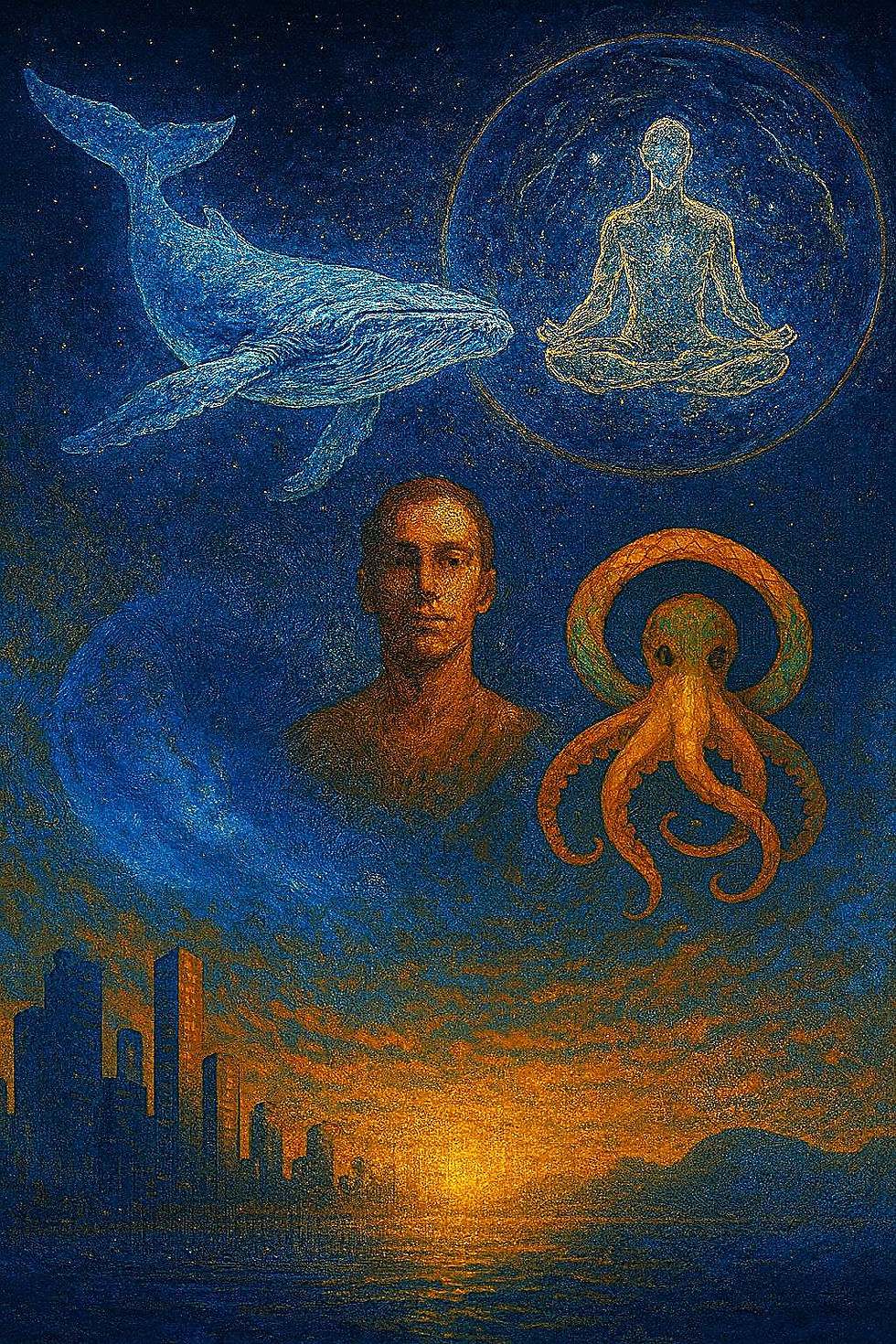
An Ouroboros — the serpent creating itself by completing the circle.
If something like this were true, then the strange beings humanity has occasionally imagined or reported need not be visitors entering our world from outside the simulation. There may be no meaningful “outside.”
They could belong to another region of the same informational structure.
They might be descendants operating from what we perceive as the future. They might be intelligences whose relationship to space and time differs radically from ours. They might occupy another level of the interface that our senses normally cannot access. Or, in the most speculative version, some could even participate in the process through which the self-simulating universe eventually closes its own causal loop.
From our perspective, such beings would appear to violate the rules of reality.
But perhaps they would violate only the rules of the interface through which we experience reality.
A character inside a dream cannot easily understand the mind in which the dream occurs. Yet in a self-simulating universe, there may be no separate dreamer.
The dream and the dreamer may be parts of the same process.
And so the question changes.
Not:
Who is running the simulation?
But:
What if reality is slowly learning how to run itself?
And Now: Visitors From the Future
There is one more possibility. Perhaps the strangest. What if some of the beings we call aliens are not extraterrestrial at all? What if they are our descendants?
We have already entertained the possibility that space may not be fundamental. But relativity joined space and time into spacetime.
So if an advanced intelligence someday learns to manipulate what we experience as spatial coordinates, perhaps the distinction between where and when will eventually become less absolute. Maybe reality's deeper informational address contains not only location but also temporal state.
Then the machine capable of bypassing interstellar distance might also contain the seed of a time machine. And suddenly the alien mystery changes again.
One Machine, Four Dimensions
Perhaps we are still making one unnecessary distinction. We speak of space travel and time travel as though they must require two completely different technologies.
But relativity already tells us that space and time belong to one structure: spacetime. Every event has not merely a place, but a place and a time. Earth today is one spacetime address. Earth one billion years ago is another. A point one billion light-years from Earth today is another.
From inside our ordinary human interface, these destinations appear radically different. One seems merely very far away. Another seems impossibly far in the past. But if space and time are both emergent features of a deeper informational reality, perhaps the underlying system does not make the distinction quite as sharply as we do.
An advanced traveler might not operate a machine with separate controls marked:
SPACE and TIME. There may be only one: DESTINATION.
The operation would not be: Move one billion light-years through space.
Nor: Move one billion years backward through time.
It would be: Change the spacetime address.
There is still an important difference between observation and actual access. A traveler who somehow appears one billion light-years from Earth at the correct location could intercept photons that left Earth roughly one billion years earlier. Looking back with a sufficiently powerful instrument, the traveler would be observing ancient Earth without entering its past. That is not conventional time travel. It is more like finding the right seat in the universe's theater from which an old scene is still arriving.
But if the deeper informational layer allows direct access to spacetime states themselves, even that enormous detour may be unnecessary. Instead of traveling a billion light-years to recover Earth's billion-year-old light, one might somehow access:
Earth — one billion years ago.
Then the true breakthrough would not be faster transportation. It would be the discovery that what we call distance and duration are different expressions of the same deeper structure. A starship and a time machine would no longer be separate inventions. They would be two uses of the same technology: navigation through reality itself.
Not Through Space. Not Through Time.
There is an even stranger implication. We have been asking whether future descendants might travel backward through time to observe us. But perhaps that language is already misleading.
If space and time are parts of one spacetime structure—and if spacetime itself is only an emergent interface—then moving a billion light-years through space and moving a billion years into the past may be variations of the same deeper operation.
From our perspective, the difference is enormous. One is a journey across distance. The other violates our ordinary idea of causality.
But an intelligence capable of manipulating the underlying informational structure might see both simply as changes of address. That creates two ways future observers might see ancient Earth.
The first requires no true journey into the past at all. Imagine that they somehow reposition themselves far enough from Earth to intercept photons that departed our planet centuries, millennia, or millions of years earlier. To them, ancient Earth would literally appear in the sky. They would be watching history by catching its escaping light. In that case the visitors would remain outside our past. They could observe us but could not walk among us. They would be spectators.
But the second possibility is much more radical. If the spacetime address itself can be accessed directly, then traveling outward to catch old photons would be unnecessary. They might simply navigate to the informational state corresponding to:
Earth — twenty-first century.
From their perspective, perhaps they have neither crossed interstellar space nor traveled backward through a flowing river called time. They have changed coordinates within a deeper reality in which where and when are inseparable. We would call it a time machine. They might call it navigation.
And if such beings appeared briefly in our skies, we would naturally ask:
Where did they come from?
But perhaps where would be the wrong question. Perhaps the correct question would be: From what spacetime address did they access ours?
The Archaeologists Who Have Not Been Born Yet
Why would advanced beings be interested in us? This question becomes much easier if they are our descendants. We are fascinated by our ancestors. We excavate ancient settlements. We reconstruct lost languages. We examine pottery fragments. We sequence ancient DNA. We spend careers studying people who died thousands of years ago.
Imagine having the ability not merely to reconstruct history but to observe it directly. Future archaeologists might look backward at us. And our era could be particularly interesting.
This is the period in which humanity developed nuclear weapons. Entered space. Began manipulating genes. Created global information networks. Built increasingly sophisticated artificial intelligence.
We may be approaching the transition between biological humanity and some new form of intelligence. If our descendants are post-biological beings, this period could be their equivalent of studying the moment when fish first crawled onto land.
They might come here not because we are advanced. But because we are becoming them.
Why Would Our Descendants Look Alien?
Give evolution and technology enough time and the answer may be obvious. They wouldn't necessarily look like us. Human bodies are compromises produced by natural selection. Our eyes, lungs, digestive systems, bones and brains evolved for conditions on prehistoric Earth.
A technologically mature intelligence might redesign all of them. Genetic engineering could modify biology. Artificial organs could replace natural ones. Brains could merge with computational systems. Bodies could become interchangeable. Some descendants might abandon biology almost completely.
After a million years, asking why they no longer look human would be like asking why humans do not look like the small mammals that survived the dinosaurs. Perhaps the familiar cultural image of the “grey alien”—large head, large eyes, slight body—is entirely fictional. But conceptually, a distant human descendant could certainly appear alien to us.
What we call a different species might simply be humanity after an enormous amount of time.
Observe, But Do Not Touch
This hypothesis also provides a fascinating version of the Prime Directive. If we could visit ancient Rome, should we give Caesar a smartphone? Probably not.
If future beings can observe their own past, interference could be extraordinarily dangerous. Perhaps they operate under strict rules: Observe. Record. Do not alter.
Maybe intervention is technologically impossible. Maybe history is self-consistent and cannot be changed. Maybe changing the past creates another branch of reality. Or perhaps civilizations that discover temporal access quickly learn that playing with their own history is a terrible idea.
This could produce the strange behavior often attributed to UFOs: appearance without introduction, observation without explanation, proximity without meaningful contact. Not extraterrestrial zoologists. Temporal archaeologists.
Of course, there is no evidence that this is actually happening. But as a hypothesis, it solves one old question by replacing it with an even larger one. The visitors do not need to cross a thousand light-years. They need to cross—or somehow access—a thousand centuries.
The Problem of Seeing the Future
Time travel immediately produces paradox. If our descendants visit us, then our future exists sufficiently for those descendants to arise.
But what happens if they tell us what happens tomorrow? Knowledge of the future changes our behavior. Our changed behavior might alter the future they came from.
Perhaps this means only the past can be observed, while interaction is impossible. Perhaps the future consists of probabilities rather than a completed history. Perhaps reality branches. Or perhaps the entire spacetime history already exists, and every visit from the future was always part of the past. We do not know.
This is no longer merely the UFO mystery. It is part of something much larger:
the Existence Mystery.
What is time? What is space? What is information? Why does reality have the structure it has? And how much of that structure does the human interface conceal? These questions remain mysterious even to our best physicists. Perhaps they always will.
Common Sense Is Not Enough
Niels Bohr is often associated with the wonderful remark that some ideas may not be crazy enough to be correct. The point is not that absurd ideas become true merely because they are absurd. Most crazy ideas are simply wrong.
The important distinction is between an idea that contradicts evidence and one that contradicts merely human intuition.
But there is another distinction as well.
An idea may not contradict existing evidence and still have no evidence specifically supporting it. String theory is an example. It is mathematically sophisticated and offers a possible framework for reconciling quantum mechanics with gravity, yet it has not been experimentally confirmed.
General relativity followed a different path. When Einstein developed it, the idea that gravity was not really a force but a curvature of spacetime was profoundly contrary to ordinary intuition. Yet the theory explained the previously mysterious motion of Mercury and made additional predictions that could be tested. Observation gradually decided the matter.
Nature never promised to make sense to a primate.
This does not free us from evidence. Quite the opposite. Because intuition cannot be trusted at the edges of reality, evidence becomes even more important. We should therefore remain capable of saying two things simultaneously:
This possibility is extraordinary. And We do not know whether it is true.
That is not weakness. That is intellectual discipline.
So Who Are the Visitors?
We began with a simple question. If unusual objects or intelligences really have visited humanity, where did they come from?
After following the question far enough, even the word come becomes uncertain. Perhaps they crossed the stars. Perhaps they originated somewhere in our own solar system. Perhaps they arose on Earth long before us. Perhaps what we see are only probes or avatars belonging to something much larger. Perhaps they access reality through informational relationships rather than traveling through ordinary space. Perhaps they operate from another level of reality that our biological interface barely detects. Perhaps some are our descendants looking backward into their own history. Perhaps none of these possibilities is correct. Perhaps the UFO phenomenon will eventually dissolve into a collection of ordinary causes. We should be prepared for that answer too.
But there is value in asking questions even when their answers turn out to be mundane. Because the greatest lesson of the mystery may not concern aliens at all. It may concern us.
We are very young. Our science is very young. The part of reality accessible to our senses is very small. And yet we have a tendency to assume that the categories we invented—space, time, life, machine, human, alien—must also be the categories used by the universe.
Perhaps they are not. Perhaps a civilization millions of years ahead would find our question—“Are they extraterrestrials?”—almost charmingly primitive. Like asking whether a radio program lives inside the radio.
The Final Possibility
There is an image I cannot quite escape. Imagine one quiet evening. A strange object appears somewhere above Earth. Someone below looks upward and wonders:
Who are they?
Inside—or behind—the object, another intelligence looks downward. Perhaps it has crossed a galaxy. Perhaps it has crossed no distance at all. Perhaps it has been here longer than humanity. Or perhaps it comes from a civilization that will not exist for another hundred thousand years.
And perhaps that observer looks at the small human figure below with something we would recognize. Curiosity. Sadness. Affection. Maybe even gratitude.
Because the creature staring upward is not an alien to it. It is an ancestor.
We keep looking at the night sky and asking: How far away did they come from? Perhaps someday the answer will surprise us. Not very far away. Just very far ahead.
And perhaps that is why the visitors may never have arrived at all.
They may simply have learned that beneath the interface, here, there, then, and now are not as separate as they appear.
The Answer We Do Not Have
After all these possibilities, we arrive at an uncomfortable conclusion. We still do not know who the visitors are. Perhaps there are no visitors at all. Perhaps most sightings are ordinary phenomena surrounded by human imagination. Perhaps a small number represent technology from another civilization. Perhaps that civilization is extraterrestrial. Perhaps it is older than humanity but belongs to Earth or the solar system. Perhaps what we call a spacecraft is only a probe, an avatar, or a temporary interface. Perhaps some visitors operate through dimensions or informational structures we cannot yet perceive. Perhaps they are descendants looking backward into their own history.
Each hypothesis explains something. Each creates new problems. None closes the case. And perhaps this is exactly where we should stop.
A mystery does not become more scientific merely because we force an answer onto it.
There is a temptation, when confronted with the unknown, to replace uncertainty with belief. Skeptics may declare that nothing unusual exists. Believers may declare that extraterrestrials are already here.
Both positions can provide psychological comfort. Neither is the same as knowing. The most intellectually difficult answer is sometimes: We do not know yet. But “we do not know” is not the end of inquiry. It is where inquiry begins.
The history of science is filled with phenomena that once had no satisfactory explanation. Lightning was divine anger. Disease was punishment or evil spirits. The stars were lights embedded in a celestial sphere. Space and time were absolute.
Then our picture changed. It will change again.
Perhaps the eventual explanation of the visitors—if there are visitors—will fit one of the possibilities discussed here. Perhaps it will be something we have not imagined. And that may be the most important lesson.
The universe has repeatedly demonstrated that it is under no obligation to remain inside the boundaries of human common sense.
So we leave the question open. Not because we have nothing to say. But because the mystery is larger than any single answer we can responsibly give.
We began by asking: Where did they come from?
We end with a different question: What if our understanding of “where,” “when,” “life,” and even “visitor” is still too primitive to recognize the answer?
For now, the honest conclusion is also the most interesting one: We do not know who they are. And perhaps we do not yet know enough about reality to know what they could be.


Comments